Building effective equality, diversity & inclusion (EDI) practice for smaller organisations video transcript
Menu
Menu
Quick Links
Slide 1: Title slide
Hello, my name is Ila Chandavarkar from the Cambridge Ethnic Community Forum or CECF. I’m with my colleague, Louise Tan, who is the Development Officer for CECF. We are a charity based in Cambridge working primarily in the field of race equality.
In this short presentation, we will be looking at tips to develop good Equalities, Diversity and Inclusion practices, which we’ll refer to as EDI.
We’ll look at how to develop the right tools to ensure effective reach and engagement with all people with characteristics that are protected by the Equality Act, which makes discrimination against these individuals or groups illegal. Discrimination is illegal, for example, on the grounds of age, disability, race, religion or belief, sex, sexual orientation, etc.
This is one of 3 recordings we have made. Part 1 is about Driving Change: by Addressing Concerns to Foster Good EDI Practice in Your Organisation. Part 2 is divided into guidance for smaller and then for larger organisations, looking at providing helpful tools and templates. This recording is for small organisations with very few or no staff.
Slide 2: Overview
This presentation will look at reasons to build good EDI practice in terms of the benefits this brings to organisations. It will then suggest some ideas for how to achieve this, suggesting ways to build effective EDI policy or guidance, as well as how you implement EDI goals through planning and action plans. At the end of the accompanying transcript, there will also be guidance links to useful resources.
Slide 3: Benefits of EDI
For more information on the benefits of EDI, please see our part 1 recording Driving Change: Addressing Concerns to Foster Good EDI Practices in Your Organisation. The link to this is included in the guidance links at the end of the transcript.
In summary, implementing good EDI practices will contribute to the following benefits:
- Wider and more effective organisational reach
- Meeting legal requirements
- Better retention of staff and volunteers
- Improved productivity
- Higher client satisfaction
- Greater creativity and innovation
- Better problem solving
Slide 4: Steps to develop good EDI practice
Here are some steps to develop good EDI practice:
Step 1
Get buy-in by involving everyone in the organisation to understand what is needed
Step 2
Develop a policy which is guidance on how the organisation will carry out EDI
Step 3
Develop a strategy, which basically says what you will do to improve EDI practice by finding the gaps in your organisation and prioritising areas to address. For each priority area, you will need to decide what data you need to collect and how.
This usually involves:
- Deciding what data you need to collect and how
- Analysing the data to see where you need to take action
- Developing an action plan and timetable
- Implement this
Step 4
Finally, review actions and lessons learned.
Slide 5: What is ‘policy’ and how does it help?
An EDI policy is a key tool in ensuring EDI. A policy gives guidance by spelling out how and what the organisation will do to achieve its EDI goals and thereby helps to provide clarity.
EDI policy should be appropriate to the size and capacity of the organisation to keep it effective and achievable. For smaller groups, the policy could be a single page to cover a general overview of how the organisation ensures EDI. We will provide links to example EDI policies for small organisations in the guidance links at the end.
We will now look at what you can put in an EDI policy.
Slide 6: EDI Policy Content
This is a list of items a standard EDI policy could contain and we are going to take you through each one in more detail in the next few slides. These are:
- A Statement of Intent (an SoI)
- A list of key aims
- Roles and responsibilities
- A Code of Conduct
- A Code of Practice and how your organisation will deal with complaints
- Review of the policy
There is a link to guidance from the Resource Centre in the transcript, which provides more information on policy content, including what is meant by reviewing your policy.
Slide 7: Statement of Intent (SoI)
An organisation’s Statement of Intent (SoI) describes:
- why the organisation is committed to EDI
- how EDI is linked to the organisation’s purpose
- the organisation’s recognition of discrimination
- organisational values and commitment to eliminate discrimination in their work.
To develop the link between organisation purpose and policy, we would recommend that you look at the example policy of Merry Street Tenants’ Association. This example policy is part of the Resources Centre guidance to help small groups develop EDI policy. A link to this is in the guidance links at the end of the transcript.
A Statement of Intent is usually displayed publicly and may list a contact for people to find out more about the organisation’s EDI policy and practice.
Slide 8: Example of EDI Aims
Here are some examples of EDI aims. These are what you aspire to achieve.
The Charity aims to:
- Provide services that are accessible, according to the need
- Promote equality of opportunity and diversity in employment, volunteering and development
- Create effective partnerships with all in our community
These aims are for a small organisation and have been taken from the Small Charity Support guidance and example policy. A link to this is in the guidance links at the end of the transcript.
Slide 9: Example Roles and Responsibilities
Here is an example of roles and responsibilities for an organisation.
The Board of Trustees are responsible for ensuring that the policy is fit for purpose for the organisation and that resources, support and leadership are provided for policy action. The Chair will ensure that these responsibilities are carried out. If there is a staff member, they are responsible for ensuring EDI in day-to-day activities. Otherwise, a named Trustee could be given this role.
Any person can report discrimination to the Chair or a staff member (if there is one). The Chair or staff member will look into the matter and report on findings to both the person who has raised the concern and the Board. The normal practice is usually to go to a staff member, if there is one, or go to the Chair if there are no staff.
It is important that the policy states that everyone involved in running the organisation has the responsibility to promote equality and to ensure there is no discrimination, regardless of whether their role is linked with particular, defined responsibilities around EDI or not.
Slide 10: Example Code of Conduct
A Code of Conduct is the behaviour that is expected in the group. For example, treating everyone with respect, not making offensive jokes, not personalising a disagreement and if you challenge inappropriate behaviour do it respectfully.
Slide 11: Example Code of Practice
An EDI Code of Practice is the practical steps you put in place to ensure EDI is present in all that you do. Sometimes it is referred to as standards for the organisation. Here is an example, from the Resources Centre model policy from the Hindu Elders’ Group provided as part of its guidance.
These are the main processes the Group follows:
- Being open and welcoming to all members
- Ensuring accessible meetings and events
- Providing interpreters
- Organising EDI training
- Ensuring EDI policy is understood by all and all commit to it.
There is a little more detail in the model. For example, how they make meetings accessible by providing transport, meeting in accessible premises, providing sign language interpreters when necessary and producing information in large print. A key part of any Code of Practice is what you have in place if there is a breach of equality and inclusion and how you deal with complaints.
In the case of the Hindu Elders’ Group, they ask that people report discrimination to the coordinator of the group and if the coordinator is unable to resolve this, the matter will be referred to the management committee. The link to this policy and Resources Centre guidance is in the guidance links at the end of the transcript.
Slide 12: EDI Strategy
Strategy here simply means how you plan to achieve your EDI aims, and the steps you will take. This will broadly involve looking at where your organisation is now in terms of meeting EDI aims and identifying areas for improvement.
This is the first stage of planning. You then prioritise the areas you wish to tackle and detail the steps you need to address these priority areas.
You may find it helpful to get advice on some areas of improvement. For example, how to reach an underrepresented group by contacting an organisation that works with this group.
Slide 13: Example EDI Strategy
Here is an example of an EDI Strategy.
Review your current status, that is where your organisation is now. For example, in August 2024:
You identify:
- That your organisation has an EDI policy, produced in 2023 and is committed to implementing EDI. However, no further measures have taken place.
After reviewing this, you identify the following priority areas for improvement:
- Awareness & training – Provide group training sessions for all staff on key aspects of EDI on an annual basis
- Inclusive facilities – review the accessibility of your premises and facilities and take action to improve access
- Increase representation – for example, this could be increasing the number of young people in the organisation
These are just some ideas you may consider. Please remember any action you choose should be practical for your group to deliver. You may choose just one item a year to focus on, such as accessibility for example.
To move forward with action, we recommend that you plan and timetable this through an annual Action Plan.
Slide 14: Action Plan
An Action Plan helps you implement the changes you have identified in an organised way. This is a
basic template for an Action Plan.
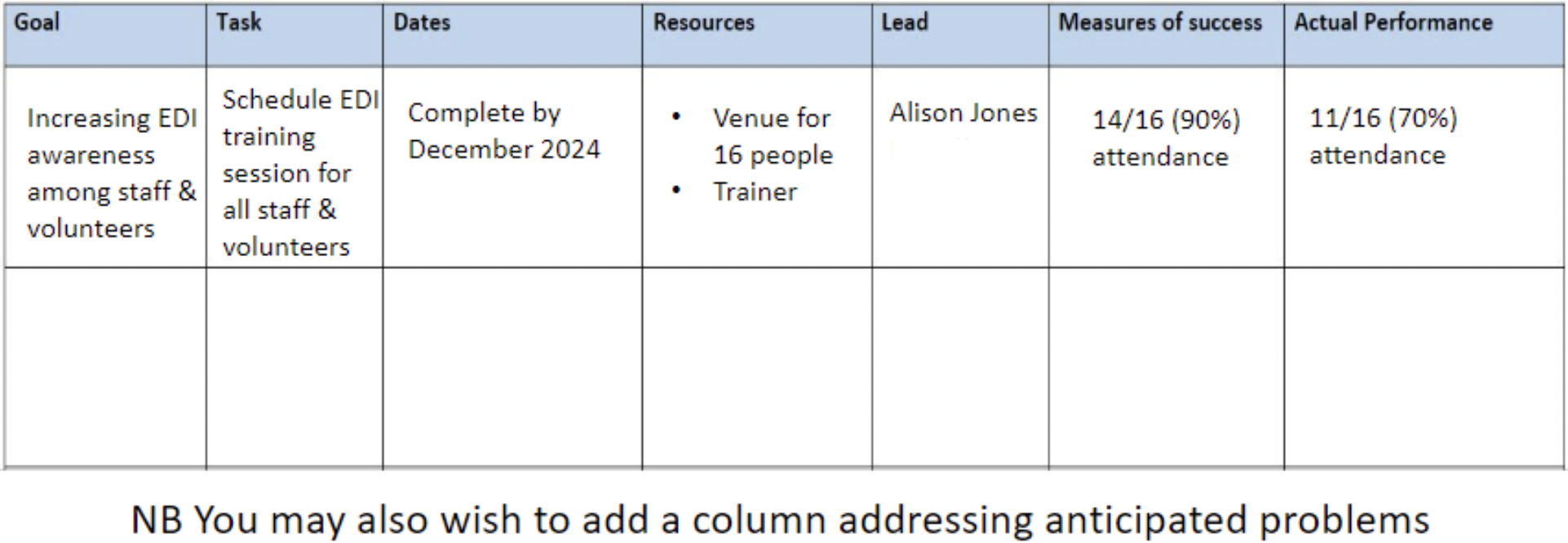
Example of an action plan table.
- Goal: Increasing EDI awareness among staff and volunteers.
- Task: Schedule EDI training sessions for all staff and volunteers.
- Dates: Complete by December 2024.
- Resources: Venue for 16 people and trainer.
- Lead: Alison Jones.
- Measure: 14 out of 16 (90%) attendance.
- Actual Performance: 11 out of 16 (70%) attendance.
You may also wish to add a column addressing anticipated problems.
Start by identifying the overall goal, such as increasing awareness of EDI among everyone in the organisation.
You can then break down how you plan to achieve that goal into tasks.
For example, schedule an EDI training session for all staff members and volunteers to attend. Input when you want to have achieved that task by and any resources you will need. You may need to hire a venue and external trainer to deliver the session for example.
Note who will be leading on this task. Also list if other people will be helping with this and the role for each one. Having a lead individual who is responsible helps to ensure there is a single focal point and the list makes clear who is doing what.
It is also helpful to identify some measures of success. In the case of training, this may be that 90% of people attend the training session.
Actual performance may indicate that only 70% of people attended the session and this will be useful in evaluating your plan moving forward. Other measures of success could be satisfaction levels and increased awareness of EDI. This could be monitored through a session register and feedback form.
You may wish to include an additional column addressing anticipated issues. For example, in achieving 90% attendance at an EDI training session, one possible issue that you could anticipate would be sickness or staff on annual leave.
Anticipating possible issues at this stage will enhance your chances of success, as you may decide that annual leave will not be approved for that day except in exceptional circumstances.
Slide 15: Monitoring & Review
Monitoring is a continuous process of collecting data to verify whether your goals are likely to be attained. It relies on data that you can easily and regularly collect. Monitoring takes place throughout the process, not just at the end.
Review or evaluation is a key stage that can be easy to overlook, but it can provide you with valuable insights. The information you have collected will assist with this review.
To what degree did you achieve your desired goal? Why was this successful or not? What are any lessons learned for future tasks, both in terms of what worked and what didn’t? Are there any additional outcomes that you didn’t expect? How has this affected your overall position in terms of EDI?
Slide 16: Example Monitoring & Review
For example, one of your goals may have been to increase the uptake of services by younger people.
You can track how well you are achieving this by looking at the numbers of under 24’s using the service at the beginning, after 3 months, and after 6 months. In this case, the project volunteer reports to the EDI trustee who decides if adjustments need to be made to what the organisation is doing to achieve the goal.
Slide 17: Summary
In summary, start with why EDI is important to your organisation and its aims. Ensure you have buy-in from everyone at the outset. Develop an EDI policy to guide this commitment into real action.
Next, it’s time to plan how you will get to where you want to be – otherwise known as strategy. Prioritise which groups or aspects you want to focus on first.
After your priorities have been established, an Action Plan will help you set out tangible and time-bound actions. You can review the success of the tasks you have set and any lessons learned.
EDI is not a one-off activity; you will want to review your overall organisational progress regularly or when serious concerns are raised. It is worth setting a date to review complaints and actions to see if there are any EDI implications. The Action Plan can be updated each year and monitored.
Monitoring, evaluation, and complaints reviews can help focus the plan for the following year. Finally, be transparent and share your organisation’s progress, both the challenges and learnings. Every goal set, action planned, and subsequent outcome, whether it meets your expectations or not, is a step towards more effective Equality, Diversity and Inclusion practice.
Slide 18: More information
For further information, please see part 1 of this video, which addresses concerns in fostering good EDI practice in your organisation and suggests solutions to overcome these.
You can also contact CECF at cecfenquiries@cecf.co.uk or Cambridge CVS at enquiries@cambridgecvs.org.uk.
Guidance links
Part 1: Driving Change: Addressing Concerns to Foster Good EDI Practice in Your Organisation
Links for policy guidance
- Equality and diversity policies for small groups
- Small Charity Support (Example Policy)
- Widowed and Young EDI Policy
- Little Faces Nursery Inclusion and Equality Policy