Menu
Menu
Funding Application Tips
Transcript
Quick Links
Slide 1: Welcome
Hello and welcome to this recording from Support Cambridgeshire. This is one of several recordings we have developed to support small charities.
To accompany the recording, there are guidance links available at the end of the transcript, which will provide you with any materials or links we mention.
Slide 2: What we’ll cover
- The basics you need in place before you apply
- Your case for support, evidencing the need for what you do
- Different types of funding
- Identifying the right funders to support your organisation
- Planning your budget
- Creating a funding plan
- Demonstrating value
Slide 3: Are the basics in place?
Most funders will be expecting you to have some basics in place; it is how funders reassure themselves that you, as an organisation, are set up to do a good job managing any funds awarded. The basics will usually include:
- Being an eligible organisation for that funder. Having a committee with at least 2 unrelated people and a governing document which outlines how you are run, including how many trustee or committee members you need to make decisions and a windup clause to show what would happen to funds in the event of your organisation closing.
- A bank account in the name of the group that requires at least 2 unrelated people to sign off on each transaction. Although if the group is new or set up to deliver a single project, the funder may agree to your funds being hosted by another voluntary group.
- A copy of your latest set of accounts, or if the funder will accept applications from new groups, you will need to create a budget of projected income and expenditure.
- Funders may also ask to see key policies and procedures such as those covering Health & Safety, Safeguarding, equality, diversity and inclusion, data protection, financial controls and risk management.
Slide 4: What is your case for support?
Most funders receive far more applications than they can possibly fund, so they have to make a choice, and this is partly based on how strong a case you make. Can you clearly explain:
- What is the need you are set up to address? For example, what barriers prevent beneficiaries from accessing the support or care they need?
- Who are you making a difference to, and how have you involved them in developing your ideas?
- How are you qualified to deliver this work, and how will you work alongside other relevant organisations?
- What evidence do you have that your approach is the right one? There are links to sources of evidence you might find useful in the guidance links at the end of the transcript accompanying this recording.
Slide 5: What sort of funding are you looking for?
Some funders will fund a wide range of different sorts of expenditure, but others may be very specific, so it is worth being clear what it is you are looking for.
Are you looking for:
- Startup costs to give you some seed funding to get started, or maybe to fund a pilot project before looking for ways to scale up your ideas.
- Core costs that contribute to the overall running of your organisation?
- Capital costs for a building or to purchase a high-value item?
- Project or revenue costs to help you deliver a specific project? Are you looking for costs to help you continue with an existing project, or to help you extend a project or develop a completely new project? It is worth being aware that most funders will not fund a project or purchase you have already started, so you need to factor in the funder’s decision times in your planning.
Slide 6: Identifying the right funders
There isn’t just one place to look for funders. A good starting point is The Support Cambridgeshire funding portal, which you can find on the Support Cambridgeshire website – you can search for funds relevant to groups in Cambridgeshire for free.
You can also subscribe to our mailing list and receive regular funding alerts.
It is also good to see which funders fund other organisations in your area or similar organisations delivering similar sorts of projects elsewhere – information about funders will be in an organisation’s annual accounts – easily available if they are a charity on the Charity Commission website.
You are probably aware of other funding directories, and free ones include Charity Excellence and Induct Grantway, which are nationally rather than locally focused.
We have a spreadsheet of smaller funds called the Invisible Grant Makers, which we can access for member organisations.
We run a fundraisers network to share information and offer support. We also arrange events to bring funders and those looking for funds together to offer guidance and support.
Slide 7: What do funders require?
Some smaller trusts and foundations may be quite general in what they say they will consider funding. However, larger foundations, lotteries and statutory funders will have funding priorities which they will outline in their guidelines.
To stand a chance of being successful, applicants will need to demonstrate that what they do fits with the funder’s priorities.
Funders may also specify the type of funding they will offer. For example, they may only fund capital costs or project costs for new beneficiary groups.
They may have other eligibility criteria, such as specific locations, or they may specify specific groups of beneficiaries.
Many of the larger funders for larger grant pots have put in place a 2 stage application process. At the first stage, they are looking to check your project meets their criteria, and for some funders, that can be achieved by submitting something other than a form, such as a simple video.
If a funder decides your project is something they might realistically fund, they may then invite you to develop stage 2 of your application, which is more detailed and may even involve a presentation.
If you are requesting a smaller sum, you will usually just go through a one-stage application process.
Slide 8: Planning your budget?
- Read the funder guidelines carefully to clarify what they will fund. For example, will they allow you to apply for Full Cost Recovery (FCR)? This means getting funding for the total costs of running your project, including overhead costs such as staff costs, heating and rent. There is a link to more guidance on FCR in the guidance links.
- Will the grant give you all the money you need? If not, can you explain how you can realistically secure the balance needed within the timescales permitted? Funders usually specify a timescale for spending funds and most will not fund retrospectively, by which I mean for activities that have already taken place or items already purchased.
- Think about whether your budget is realistic. Funders know what things cost, and putting in the lowest possible cost may lead to concerns about your ability to deliver. Conversely, putting in high costs that don’t reflect value for money may count against you.
- Funders are also likely to ask you about how you will sustain your project or activities when their support comes to an end. It may be that their funding will build your capacity to raise funds in other ways or that you intend to apply for further grants, so that the gains made are not lost.
- Finally, make sure you budget adds up correctly – this is a common mistake and one that will make a funder question your ability to manage their funds effectively.
Slide 9: Creating a plan
Grant funding is one way you can seek to raise funds, and you probably also raise money in other ways, such as through donations or running fundraising events.
It can be helpful to incorporate grant applications into a wider plan reflecting timescales and resources you’ll need to allocate.
Funders operate on different time scales, with different deadlines and lead times. Having identified which funders you want to apply to, you need to factor all of these differences in.
We’ve shown here an extract from a simple fundraising plan which would help you map out your approach to raising funds.
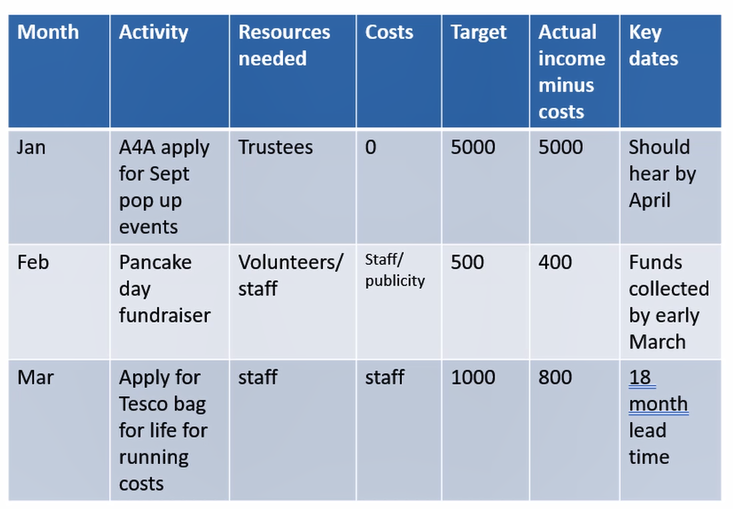
You can see that it takes into account how long funders take to make decisions and the resources and costs involved.
You can also add in key operational dates for your organisation, for example, when you might be especially busy or when cash flow might be a particular concern.
Slide 10: How to show the value of what you do?
Most funders will require you to monitor and evaluate your project to collect information to demonstrate the difference your project or activities make to your beneficiaries.
For example, if your project is set up to reduce loneliness, how can you reflect this? Funders will often specify the sorts of proofs they require.
Some will expect you to put in place a way of measuring the difference made; they may want to know numbers attending events, or they may want to read case studies sharing the impact.
It is common for funders to ask you at the application stage to explain how you will evaluate your project. Usually, the more money you ask for, the greater the level of monitoring and evaluation required.
There are links in the guidance to offer more information on monitoring and evaluation.
Slide 11: To sum up
Get the basics in place and develop a plan around fundraising. Create a case for support which includes sharing evidence of need. Do your research and make sure you know what funders are looking for and whether they are a good fit for you.
Think about how you will demonstrate the difference your work makes to the people you are set up to help. Look for ways to convey your vision, be positive and persuasive and use your stories.
Be resilient, there is a lot of competition for grants, and you are very unlikely to be successful every time, but ask for feedback where available on any failed bids and take the opportunity to learn and develop your skills.
Look for guidance and support. Support Cambridgeshire can help. We have lots of resources and networks you can tap into, so get in touch.
Guidance links
For evidence of need, look at:
- Cambridgeshire Insight
- Office for National Statistics
- NOMIS labour market statistics
- Office for Health Improvement and Disparities – GOV.UK
- NCVO Help and Guidance
- Lottery Guide to evidencing need
- The BIPC Network
- Tools to help you gather and use evidence and learning
Find funders
To find funders, check out:
- Support Cambridgeshire funding database
- Charity Excellence
- Induct Grantway
- Training and events
- Charity Commission search directory
Cost Recovery
Contact Us
To find out more and for further help and guidance, please contact us at info@supportcambridgeshire.org.uk
Share via social media:

